Transforming Your Drift Machine using Actionable Analysis provided by a Advanced Suspension Tuning Software
In the demanding world of today's professional oversteer competition, success is not merely purely a function of brute horsepower or pilot aggression. Instead, it has become a intricate engineering challenge that requires a scrupulous fusion of choosing a time-tested vehicle platform, arming it with the highest-quality drift-spec parts, and, most essentially, understanding its real-time characteristics on the course through advanced suspension tuning applications. This definitive guide will serve as your blueprint starting from the very first idea of a drift build all the way to the final telemetry-optimized refinements that turn a powerful machine into a consistent podium finisher. We will thoroughly explore the methodical process of car suspension tuning, demonstrating how a modern vehicle dynamics tool like a dedicated telemetry system eradicates approximation and offers exceptional clarity into your chassis's real-world dynamics.
The bedrock of any successful competitive sliding vehicle is, indisputably, the base vehicle itself. Several vehicles have attained renowned standing within the international sliding scene due to their natural weight distribution, strong build quality, and the vast ecosystem of aftermarket components available. Picking the optimal car is the initial and most significant decision a builder will make. For instance, the the E36 generation BMW is commonly accepted as perhaps the the finest overall drift cars of all time. Its excellent evenly distributed mass, combined with a RWD layout and bulletproof six-cylinder powerplants, establishes a chassis that is at once accessible for beginners and highly effective in the control of a professional competitor. The successor of this lineage, the BMW E46 platform, improves on these attributes with a more developed structure, wider wheel track for enhanced confidence, and still more turning capability directly from the factory. A distinct powerful contender in the pro arena is the Corvette C6.
This V8-powered sports car introduces a unique combination of advantages to the sideways discipline, featuring a light alloy frame, a rear-mounted gearbox and differential unit that contributes to an ideal weight distribution, and the tremendous torque of a big LS-series V8 engine. This blend makes it an utter force on track, able of entering and maintaining extended drifts with apparently minimal application of power. For those looking for remarkable value, the 350Z model Nissan stands out as a top-tier candidate. It arrives from the factory with a robust chassis, a effective original limited-slip differential, and the free-revving V6 engine that provides sufficient performance for learning and advancing in the discipline. Its successor, the 370Z model, presents more refinements in structural rigidity, handling precision, and peak engine power, solidifying its status as a common choice among competitive drivers. Further historic platforms that deserve consideration encompass the agile unique Mazda FC RX-7, the ubiquitous S13 Silvia/240SX, the V8-powered Ford SN95, the electronic-equipped BMW E90, and the small yet incredibly fun and teachable MX-5 Miata. Every single one of these cars offers a distinct palette of attributes, complexities, and possibilities, but they all possess the basic components essential to serve as a serious sliding vehicle.
However, picking the optimal platform is just the starting point. To access the complete performance of every of these cars, substantial upgrades to the steering system and damping and springing systems are completely mandatory. This is where the domain of precision aftermarket components becomes vital view. The single most transformative upgrade for a purpose-built competition vehicle is the integration of a maximum-angle steering angle kit. These advanced kits, for example those manufactured by performance brands like SLR Speed, are engineered to radically expand the chassis's available steering angle. A standard road car is extremely limited in how far its front wheels can pivot, a engineering compromise for on-road driving. In sliding, conversely, aggressive countersteering is continuously necessary to manage and sustain a slide. An angle kit substitutes the OEM hubs, linkages, and sometimes control arms with parts that enable the steered wheels to attain steering lock in excess of 70 or even 80 degrees, versus a average stock angle of around 40 to 50 °.
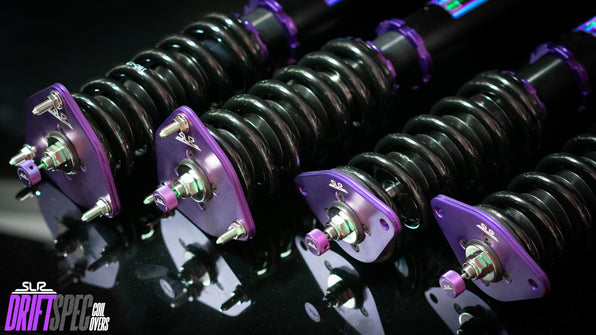
This tremendously greater steering angle provides the driver with exponentially greater command during a slide, allowing it to be much simpler to start a oversteer moment, hold it through a sweeping bend, and change fluidly from one side to the opposite. The improvement in handling is truly profound. Combined with a appropriately chosen steering kit is the just as essential modification to the car's damping system. Off-the-shelf or even high-end street dampers are generally not intended for the specific and harsh requirements of drifting. A dedicated set of suspension units is of utmost importance. These specific dampers feature custom piston tuning and spring strength that are tuned for the rapid weight transfer that is characteristic of aggressive driving. When a operator starts a drift, the vehicle's inertia is transferred forcefully to the outside of the bend. Correct drift-spec coilovers handle this movement in a predictable fashion, permitting the car to settle promptly and providing the driver accurate feel through the steering wheel and cockpit. They furthermore enable precise setting of ground clearance, damping rate, and cross-weight, which are all integral elements of fine-tuning the chassis's behavior to a specific venue or piloting approach. In combination, a high-quality angle modification system and a correctly specified system of drift-spec suspension units form the core physical cornerstone upon which all later refinement is constructed.
Once the core components is installed, the subsequent critical stage in the build is the detailed adjustment of the car's suspension geometry. This is the world of vehicle alignment optimization, a procedure that can appear overwhelmingly complex to the beginner but is, in reality, the key to transforming a assembly of high-performance components into a unified and consistent whole. The most debated parameter of alignment for drifting is definitely negative camber. Camber angle is the tilt of the wheel compared to the perfectly straight axis when viewed from the forward of the car. When the top of the wheel is angled inward, this is called negative camber. In sliding, an inward tilt on the front tires is generally employed and is considered essential. The logic is fundamentally linked to tire contact.
When a car is cornering at limit slip angles, the body tilts towards the outside of the bend. This body roll causes the outer steering tire to lose its best grip area with the track surface. By introducing inward lean, the tire is pre-leaned to compensate for this lean. As the vehicle rolls into the bend, the tire becomes more upright with the track, maximizing its bite at the exact point when it is most required for control. Commonly, front adjustments for a serious sliding vehicle vary from approximately -3 degrees to as much as -5 degrees or even greater, depending on the details of the chassis configuration, compound selection, and operator preference. The back wheels also use negative camber, but the angles are generally more conservative and subtler than the front axle. Excessive inward lean at the back can cause the vehicle to overly prone to oversteer and difficult to manage on acceleration use, as it shrinks the available tire footprint of the powered wheels during straight-line power delivery. Hence, rear angles are commonly in the range of -1 degree to -3 degrees, finding a precise balance between offering sufficient lateral grip to assist in initiating and holding the drift while simultaneously keeping usable grip for power-down the bend. Camber is just one part of the more complex tuning picture, which also encompasses toe angle, self-centering steering, and steer correction modification.
Toe setting describes the direction of the wheels when viewed from a bird's-eye view. Toe-in means the leading edges of the wheels are closer together than the rear edges, while outward toe means the opposite. For sliding, a modest amount of front toe-out is often employed to quicken the turn-in directional feel, making the chassis feel more responsive and ready to begin a oversteer moment. Rear axle toe angle is generally set to neutral or a incredibly minute car suspension tuning amount of positive toe to foster straight-line stability under throttle. self-centering is the longitudinal or aft inclination of the suspension pivot when observed from the lateral of the chassis. More positive caster improves feedback and high-velocity confidence, and it also increases negative camber gain during steering, which is extremely useful. Adjusting these parameters is a detailed dance where a adjustment to one setting can and will influence the remaining parameters. The old-school approach for dialing in a car's suspension geometry for competition has for a long time been a time-consuming process of trial and error. A tuner or engineering group would apply a change based on experience, run the vehicle on track, rely on the driver's individual sensation and feedback, and then introduce an additional change. This cycle would iterate again and again until the car felt "acceptable" or the allotted track period was exhausted. This methodology is not just extremely inefficient in terms of man-hours and tires, fuel, and parts, but it is also deeply inaccurate.
Human sensation is a infamously subjective metric, influenced by many variables such as exhaustion, varying track conditions, ambient heat, and simply the focus of the pilot on that given session. What feels "tail-happy" on one run might feel "pushing" on the following lap, resulting in confusing information and frustrating changes. This age-old problem in car suspension tuning is specifically where modern telemetry systems has stepped in to transform vehicle dynamics tool the process.
The rise and application of sophisticated suspension tuning applications has brought about a radically different era for tuning and optimizing high-performance sliding vehicles. These tools, showcased by groundbreaking systems like GripDial, operate by actively measuring the live dynamic performance of the vehicle as it is operated on the course. Unlike depending on driver feedback, these tools collect measurable data on key variables such as damper compression and extension, wheel speed, G-force loading, lock position, and throttle and brake position. This collected telemetry is then interpreted by powerful software that can graph and analyze the metrics in a actionable format. For the first time, tuners and teams can observe precisely what the vehicle is exhibiting at each point of a lap. This capability transforms the entire suspension tuning procedure. Think about the particular task of optimizing the front axle negative camber for a specific chassis. Rather than applying a adjustment from -3 degrees to -3.5 degrees and then testing several runs to try and "sense" a change, a vehicle dynamics tool can deliver instant and clear data. The application can show graphically how the tire's contact patch is behaving during the key moments of a angle: the initial flick, sustain, and switch. It can show if the current camber setting is allowing the loaded tire to achieve ideal grip or if the rubber is overloaded on its outer shoulder.
The software can subsequently provide data-driven recommendations for modification. Perhaps the information indicates that the tire is even overworking its edge at -3.5 degrees of camber, suggesting that a move towards inward lean, say -4 degrees, might be advantageous. Conversely, the information might indicate that the tire is not achieving optimal operating temp or that the inner edge is degrading excessively, which could point to that there is overly aggressive inward lean and a slight lessening back to -3.2 degrees would be better optimal. This standard of accuracy and actionable analysis was literally unimaginable in the time of solely mechanical setup.
The impact of employing a advanced vehicle dynamics tool reaches well beyond only dialing in camber. It functions as an invaluable damper adjustment manual that is customized to your exact vehicle. When adjusting the shock absorber settings on your suspension, instead of using vague guidelines or copying another car's setup, you can utilize the telemetry to observe how the chassis is reacting in reaction to your changes. The application can show the wheel movement trace over a run, revealing if the shocks are handling the body movement optimally or if they are allowing the chassis to become unsettled too much after a flick. It can help in identifying challenges like bottoming out or excessive extension, enabling you to apply data-backed adjustments to preload settings, rebound/compression values, or ride height. This methodology extends equally to the intricate art of car alignment tuning. Beyond camber, the software can offer insight into how adjustments to toe settings and caster angle are affecting the car's balance during specific parts of a drift. For example, it can assist you to find the best amount of front toe-out for your particular steering rack geometry and competition style by measuring the quickness of turn-in reaction and the predictability of the vehicle at full steering angle. This makes the tool an extremely effective performance optimization handbook that is dynamically updated by the actual performance of your own vehicle on the circuit. It shifts the whole process from a mysterious craft into a methodical optimization procedure.
Additionally, the application of a tool like data acquisition is in no way confined to professional engineers with large resources. For the amateur enthusiast, it serves as an amazing equalizer. It practically gives the builder with the insight of a professional race engineer without the typical overhead. It drastically shortens the tuning process by giving unambiguous answers to questions that would otherwise take countless track days of experimentation to answer. A builder can learn how their specific vehicle behaves to various inputs, building a more intuitive knowledge of car control in the endeavor. It also opens up professional chassis dynamics concepts, permitting all drivers with the desire to refine their machine to achieve it in a structured and successful fashion. This is especially important suspension engineering in a activity like sliding, where setup expertise has traditionally been a closely guarded advantage among elite teams. In the modern era, that capability can be in the hands of every dedicated builder.
In summary, the journey to constructing and tuning the ideal championship-contending drift car is a comprehensive project that seamlessly blends classic engineering principles with 21st-century digital solutions. It starts with the strategic choice of a proven car, followed by the integration of non-negotiable drift-spec parts like high-performance drift angle kits and correctly selected competition suspension units. The process then moves into the detailed phase of car suspension tuning, where settings like negative camber, toe, and caster angle are meticulously set to complement the vehicle's modified hardware and the driver's individual needs. Finally, and what really separates the contemporary process from the past, is the adoption of a advanced drift telemetry software. This system removes the approximation and inefficiency of solely seat-of-the-pants adjustment by providing quantifiable, actual information on how the vehicle is actually behaving. It functions as an incredible suspension tuning tool, a definitive alignment optimization handbook, and a master chassis development system. As a complete package, this holistic methodology guarantees that each and every element of the competition vehicle—from the selection of the chassis to the final click on the coilover—is refined for peak success on the competition venue. It embodies the total evolution of the sport of drifting, bridging raw driving skill with precise chassis dynamics to build the ultimate competitive cars imaginable.